Smarter Sourcing
The Smarter Sourcing podcast is dedicated to helping sourcing, procurement, and finance leaders elevate their influence and get their seat at the table. Each episode features conversations with innovative leaders, sharing best practices, lessons learned, and actionable insights you can apply immediately. Whether you’re focused on procurement strategies, supply chain optimization, or aligning financial goals with operational excellence, this podcast will leave you with actionable insights that you can immediately put to work.
Listen on:



Episodes

Thursday Jul 31, 2025
Thursday Jul 31, 2025
Arvind Nathan, SVP of Private Brands & Sourcing at The Michaels Companies, Inc., didn't plan to revolutionize how global teams think about private brand sourcing, but his mathematical approach to procurement has transformed operations in both his current role and his previous one at Walmart. Managing 220 people across Asia and the US taught him that successful sourcing isn't about having better tools than competitors — it's about building the right equation from available variables.
Arvind's framework treats every sourcing decision as part of a balanced equation where over-indexing any single variable can destroy the entire strategy, whether that's cost, quality, speed, or innovation. At Michaels, he oversees 14-15 private brands that must reflect the retailer's identity while competing against national brands with established equity. His team operates on three core principles that have proven essential as the distance between supply and demand continues to shrink in global commerce.
Topics discussed:
The mathematical framework for balancing sourcing variables without over-indexing any single factor like cost, quality, or delivery speed.
How private brand sourcing complexity exceeds national brand challenges due to retailer reputation risk and personalization requirements.
Building cultural alignment across 220-person global teams through shared experiences, open dialogue, and cross-functional storytelling.
The evolution of supplier assessment from basic cost-quality-delivery metrics to 15-dimensional evaluations, including e-commerce capabilities and cross-functional support.
Strategic approaches to crisis management learned from 2008 and 2020 disruptions, emphasizing fundamental strength over contingency planning.
The transformation of supplier relationships from transactional manufacturing focus to revenue generation and innovation partnership models.
Leadership principles for global procurement teams including ready-aim-fire decision making, alignment without agreement, and Formula One pit stop operational speed.
Cultural adaptation strategies for international business including curiosity as active respect and understanding rather than navigating differences.
Technology integration challenges in procurement including AI limitations and the continued importance of human relationship management.
Career development advice emphasizing curiosity, agility, exposure to challenges, ownership mindset, and people business fundamentals.

Wednesday Jul 16, 2025
Wednesday Jul 16, 2025
David Pennino, CEO & Founder, built LogicSource by recognizing that indirect procurement represents the largest untapped opportunity for most enterprises. His conversation with John highlights how a company processing $150 billion in spend data approaches categories that consume 20% of revenue but receive minimal professional attention. David's methodology challenges traditional consulting models through comprehensive free assessments and frequency-based expertise that most organizations cannot develop internally.
David discusses his unique assessment-first approach, explaining how this model achieves a 93% win rate by proving value rather than promising it. His team's frequency advantage demonstrates how specialized expertise scales across complex procurement categories. The conversation also explores LogicSource's expansion into healthcare, where "wedding pricing" creates unique opportunities for systems that cannot pass cost increases to patients.
Topics discussed:
The development of LogicSource's free assessment model and why it outperforms traditional consulting approaches in procurement transformation.
How frequency-based expertise in categories like software licensing, marketing services, and facilities management creates sustainable competitive advantages over internal teams.
The strategic addition of healthcare markets and why hospital systems face unique pricing challenges that indirect procurement can address.
Building category expertise by hiring professionals from both supplier and buyer sides to understand complete cost structures and margin opportunities.
The evolution of procurement from "three bids and a cloud of dust" methodology to comprehensive category management that considers relationships, quality, and strategic value.
Why GPOs often underperform compared to enterprise-specific procurement strategies for larger companies with significant spend volumes.
The importance of vision sessions in aligning procurement strategies with broader business objectives beyond simple cost reduction.
How AI will enhance procurement decision-making while requiring domain experts to train and validate machine learning outputs.

Tuesday Jul 01, 2025
Tuesday Jul 01, 2025
Sean Park, VP of Procurement and Transformation at Arm, didn't set out to revolutionize procurement at Arm, but when you're scaling a $4 billion semiconductor company at 20% year-over-year growth without adding procurement headcount, revolution becomes necessity. Sean offers John a peek at how Arm achieved nearly 20% savings on an 8-figure server deal using AI agents that required zero human intervention once launched, completing negotiations in days rather than weeks.
He also shares his SPORT framework — Strategy, Processing & Policy, Organization, Reporting, Technology — that represents a complete reimagining of procurement priorities, while his prediction that 20-40% of procurement knowledge becomes obsolete annually reflects the accelerating pace of change facing the profession. Sean's vision for procurement as a consumer-grade experience, combined with his philosophy of supplier relationships rooted in mutual respect rather than adversarial negotiations, offers a blueprint for procurement leaders navigating AI transformations of their own.
Topics discussed:
The SPORT framework for procurement transformation, encompassing Strategy, Processing & Policy, Organization, Reporting, and Technology as interconnected elements.
Implementing AI-powered negotiation agents that achieved 18% savings on 8-figure server procurement with zero human intervention after launch.
Scaling procurement impact at a $4 billion company experiencing 20% year-over-year growth without increasing team headcount.
Cultural lessons from Japan on the power of listening before reacting, and how this approach transforms stakeholder relationships in high-margin industries.
Supplier relationship philosophy based on mutual respect and interdependence rather than adversarial price-focused negotiations.
The accelerating obsolescence of procurement knowledge, with 20% or more becoming irrelevant year-over-year thanks to AI advancement.
Organizational design featuring business partners vertically oriented by function rather than horizontally by category to improve stakeholder experience.
Technology-first approach, where breakthrough tools drive changes in organizational structure, processes, and strategic objectives.
Creating consumer-grade procurement experiences through unified platforms, chatbot integration, and simplified stakeholder interfaces.
Predictive sourcing and negotiation platforms that accelerate savings maximization while maintaining supplier relationship quality and service.
Geographic and functional coverage strategies for global procurement operations spanning multiple continents and complex supplier ecosystems.
Wednesday Jun 18, 2025
Wednesday Jun 18, 2025
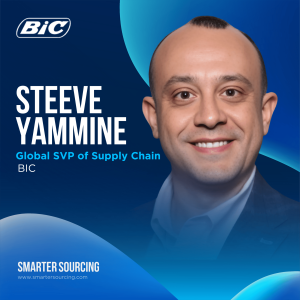
Managing 8+ billion products annually across 180+ countries while reducing logistics footprint by 27% requires more than traditional supply chain thinking. Steeve Yammine, Global SVP of Supply Chain at BIC, has orchestrated this complex operation by fundamentally reimagining how global companies approach contingency planning, regionalization, and talent development.
He tells John his journey from brewery night shifts in Belgium to steering one of the world's most recognizable consumer goods supply chains offers practical frameworks for building resilient, efficient operations. Steeve also touches on how BIC transformed from inventory-heavy contingency planning to dynamic scenario mapping, implemented meaningful sustainability initiatives beyond product redesign, and developed a hiring philosophy that prioritizes critical thinking over technical knowledge in an AI-driven landscape.
Topics discussed:
The evolution from inventory-based contingency planning to dynamic scenario mapping using digital tools that activate different responses based on real-time conditions rather than stockpiling safety stock.
Implementing a regionalization strategy that balances proximity to demand with strategic global redundancy, ensuring dual sourcing across different geographic regions to avoid single points of failure.
Achieving a 27% reduction in logistics footprint through better planning and technology optimization rather than traditional cost-cutting measures.
Developing sustainability initiatives that focus on supply chain footprint optimization alongside product innovation, including 78% ocean plastic content in select pen lines and refillable lighter systems.
Building and managing culturally diverse teams across global operations while maintaining operational coherence through people-first leadership and cross-cultural communication strategies.
Talent selection philosophy, emphasizing 80% focus on problem-solving approach and critical thinking skills versus 20% on technical knowledge, recognizing AI's impact on skill requirements.
Managing the complexity of vertically integrated manufacturing where BIC produces everything from raw resin to finished products across 20+ factories globally.
Strategies for navigating geopolitical uncertainties and tariff fluctuations while maintaining supply chain stability and avoiding constant operational disruptions.
The transformation of supply chain leadership from operational support roles to strategic business partners with seats at executive decision-making tables post-COVID.
Integration challenges and supply chain strategies for recent acquisitions like Tangle Teezer and Inkbox, expanding BIC's portfolio beyond traditional product categories.

Tuesday Mar 25, 2025
Tuesday Mar 25, 2025
"I'm a fireman," is how Yelena Mogelefsky, SVP of Production and Sourcing at Komar describes her role to her children — a perfect metaphor for the daily crisis management that defines sourcing leadership in fashion. In this captivating episode of Smarter Sourcing, Yelena walks John through how she transformed an entrepreneurial opportunity into a $150+ million division over 14 years.
From navigating the complexities of intimate apparel to managing a global team across Sri Lanka, Hong Kong, and the U.S., Yelena reveals how fashion industry sourcing has evolved beyond cost-cutting to become a sophisticated discipline balancing sustainability, transparency, supply chain resilience, and value creation in an increasingly unpredictable geopolitical landscape.
Topics discussed:
The entrepreneurial journey of building Komar's intimate apparel division from virtually nothing to a $150+ million business, demonstrating how calculated career risk-taking and strong industry relationships can drive exponential growth.
Komar's strategic shift from cost-focused procurement to holistic value creation, measuring success through metrics like cost aversion, chargeback prevention, container optimization, and packaging efficiency rather than simply lowest prices.
How Komar structures its procurement with a decentralized approach for general sourcing but maintains a centralized team specifically for their nutrition arm, illustrating how manufacturing businesses can tailor their sourcing organization to product-specific needs.
Implementing robust supplier vetting practices after a crisis situation with a Chinese manufacturer revealed financial instability, showcasing how deep supply chain verification prevents costly production disruptions.
The critical importance of transparency and traceability in modern sourcing, with Komar developing a proprietary technology platform to track their complete supply chain from raw materials to finished products.
Tactical strategies for sustainability implementation, including consolidating fabric orders to achieve cost-neutral recycled materials and working collaboratively with factories to improve their environmental practices rather than simply eliminating non-compliant suppliers.
Practical China sourcing mitigation strategies in response to geopolitical uncertainty and tariff increases, reducing Chinese manufacturing footprint from a majority position to just 20-30% of production through strategic diversification.
Education gaps in preparing future sourcing professionals, particularly in hands-on technology experience, real-world problem-solving skills, and communication techniques for managing international supplier relationships.
Tuesday Mar 18, 2025
Tuesday Mar 18, 2025
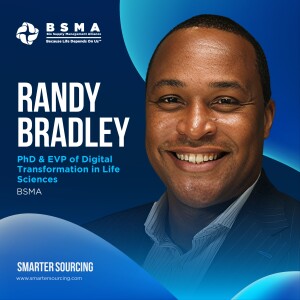
"If your supply chain only reduces costs, it's not a strategic asset — it's a commodity," Randy Bradley, PhD & EVP of Digital Transformation in Life Sciences at BSMA, tells John in this episode of Smarter Sourcing. When 80% of executives claim their supply chain is strategic but expect it only to cut costs, Randy helps expose the disconnect that keeps procurement leaders trapped in operational thinking.
Drawing from 25+ years bridging technology and supply chain, he explains why healthcare organizations relegate their supply chains to "the basement next to the morgue" and provides a roadmap for elevating procurement's role through liquid data assets and a critical mindset shift from resilience to agility.
For procurement professionals tired of being cost-cutters instead of value-creators, Randy's frameworks for translating operational metrics into C-suite language will transform how you position your function's strategic impact.
Topics discussed:
How to distinguish between commoditized and strategic supply chains by examining whether they contribute to top-line revenue generation rather than just cost reduction.
Translating operational metrics into C-suite language and how to convert supply chain KPIs like inventory turns into financial metrics that executives care about.
Why healthcare's operational excellence mindset and failure to reconcile competing global supply dynamics has prevented innovation and strategic elevation.
The "resilience vs. agility" framework for supply chain strategy and why organizations should strive for agility (emerging with new capabilities) rather than mere resilience (weathering challenges) when facing disruptions.
A three-part methodology for developing data that can be easily recombined, monetized, and shared through engaged data democracies that break down departmental barriers.
Why focusing on using AI to eliminate distractions rather than replace jobs allows organizations to unlock human intellectual potential and avoid the resistance that causes organizations to fall behind.
Embedding risk management as core business practice and how to shift from reactive disruption response to proactive capability building that prevents supply chain disruptions from causing business interruptions.

Thursday Feb 06, 2025
Thursday Feb 06, 2025
What does it take to transform procurement from a cost center into a strategic value driver? Johnathon Baker, Operating Partner & Head of Strategic Sourcing and Procurement at Apollo Global Management, shares his expertise in procurement transformation, gained from leading strategic initiatives at major companies like Starbucks, before taking on his current role at Apollo.
His discussion with John on this episode of Smarter Sourcing explores how Johnathon’s team drives value across Apollo's portfolio companies through strategic sourcing, leveraging AI and analytics while building strong CPO partnerships. From managing complex supplier relationships to preparing for global economic shifts, Johnathon offers valuable insights into modern procurement leadership and the evolution of sourcing from a back-office function to a strategic business driver.
Topics discussed:
The evolution of procurement into a strategic business function driving organizational value and operational excellence.
Transformation of procurement practices at Starbucks during the 2009 recession, particularly cost reduction while maintaining supplier relationships.
Building effective partnerships with portfolio company CPOs while driving significant cost savings and operational improvements.
Leveraging AI and analytics to manage complex procurement data across Apollo's extensive portfolio of companies.
Preparing portfolio companies for economic shifts through scenario planning and strategic supplier relationship management.
The importance of balancing cost-reduction goals with maintaining strong supplier partnerships and business growth.
Implementation of technology solutions to streamline procurement processes and enhance decision-making capabilities.
Managing procurement transformation across diverse portfolio companies while maintaining individual company autonomy.
Development of procurement talent and the changing skill sets required in modern strategic sourcing.
Creating value through procurement beyond cost savings, including revenue growth and operational efficiency improvements.
Thursday Dec 19, 2024
Thursday Dec 19, 2024
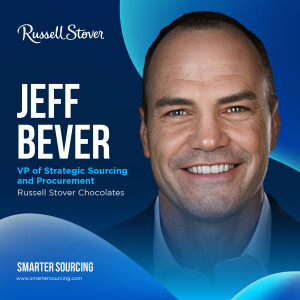
In this episode of Smarter Sourcing, John welcomes Jeff Bever, VP of Strategic Sourcing and Procurement at Russell Stover Chocolates, to discuss how a 100-year-old company is transforming its procurement and supply chain operations for the modern era. Jeff reflects on his diverse career journey across agriculture, construction, and confectionery, sharing how each experience has shaped his leadership style.
He discusses the challenges of building sustainable supply chains, managing cocoa supply in a volatile market, and using an enterprise-wide mindset to drive business value. Jeff also discusses mentoring the next generation of supply chain professionals and the evolving role of AI in procurement.
Topics discussed:
How diverse career experiences across industries drive innovation in procurement and sourcing.
The importance of building trust and relationships across global management teams.
Sustainability challenges in cocoa supply chains, including pricing volatility and farmer welfare.
Why a growth mindset is critical for sourcing professionals and team building.
The enterprise mindset: thinking beyond silos to drive holistic business value.
The role of AI and technology in accelerating procurement innovation and decision-making.
Contingency planning for a constantly volatile supply chain landscape.
Mentoring the next generation of supply chain leaders to think beyond traditional boundaries.
Aligning procurement strategies with broader organizational goals and future growth.
Thursday Dec 12, 2024
Thursday Dec 12, 2024
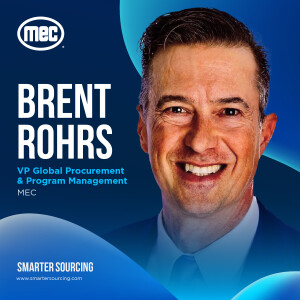
In this episode of Smarter Sourcing, John speaks with Brent Rohrs, VP of Global Procurement & Program Management at Mayville Engineering Company (MEC), to discuss the evolving world of procurement and supply chain management. Brent shares insights from his career, including the importance of centralizing procurement operations to enhance supplier collaboration and efficiency.
Brent and John also explore lessons learned during the pandemic, such as managing supply chain risk and balancing cost with lead times. Brent offers advice on embracing cross-functional learning and building resilient teams in today’s dynamic environment.
Topics discussed:
Navigating global supply chain disruptions and the need for stronger risk management strategies in an unpredictable world.
The benefits of centralizing procurement operations to leverage scale, reduce costs, and enhance supplier collaboration.
How cross-functional learning fosters team collaboration and problem-solving across diverse groups and industries.
Lessons from the pandemic, including balancing cost, lead time, and inventory to meet unprecedented demand.
Strategies for building supplier partnerships and treating suppliers as extensions of internal operations.
The value of understanding numbers and cost drivers, even without a finance background.
Developing resilient teams by encouraging open communication and communal learning across all levels of an organization.
Embracing diverse career experiences and taking on challenges outside your comfort zone to grow professionally.
The role of technology in modernizing procurement, from supplier portals to artificial intelligence applications.
Key skills for supply chain professionals, including emotional intelligence and effective relationship-building with vendors.
Monday Dec 02, 2024
Monday Dec 02, 2024
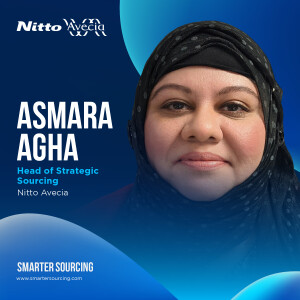
In this episode of Smarter Sourcing, John speaks with Asmara Agha, Head of Strategic Sourcing at Nitto Avecia, who shares her insights on the evolving landscape of supply chain management. She discusses the critical role of resilience and adaptability in navigating challenges, especially in the wake of the pandemic.
Asmara emphasizes the importance of leveraging AI and predictive modeling to enhance efficiency and risk mitigation. Additionally, she highlights her commitment to empowering women in the industry and fostering a culture of collaboration and innovation.
Topics discussed:
The significance of resilience in supply chain management, particularly in overcoming challenges posed by global events like the COVID-19 pandemic.
How AI and predictive modeling can enhance efficiency and risk mitigation in supply chain operations, enabling better decision-making and planning.
The importance of contingency planning and having multiple strategies in place to address potential disruptions in the supply chain.
The role of emotional intelligence and soft skills in negotiations and relationship management within the supply chain industry.
Initiatives for promoting women empowerment and leadership within the supply chain sector, addressing the challenges women face in advancing their careers.
The impact of sustainability and green procurement practices on supply chain strategies and the importance of reducing carbon footprints.
Insights into the technological advancements in Japan and how they can influence supply chain practices in other regions, particularly in the U.S.
The necessity of training and development programs for supply chain professionals to adapt to changing technologies and market dynamics.
Approaches to vendor management and building strong relationships with suppliers to foster innovation and collaboration in sourcing.